logo

Saturday, October 3, 2009

On Economic "Fixes" and Health Care "Reform"

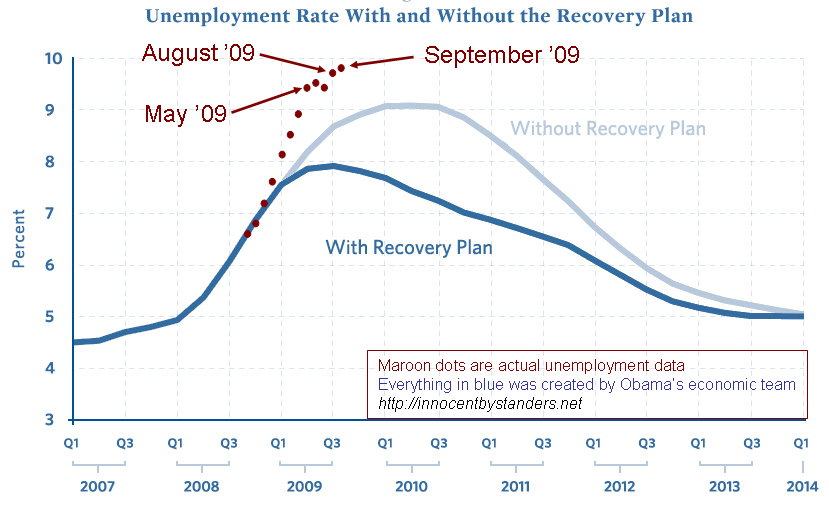
So because of (demonstrably not "despite") the Spendulus, unemployment is now at record highs, twice what it was under the previous administration, and showing no signs of easing:

And again we ask, why would we even consider putting these guys in charge of our health care?

[Chart courtesy of Innocent Bystanders]

Friday, October 2, 2009

Social Security vs Medicare: Making Waves, Progress

Quick background: Under existing rules, if one elects not to be covered by Medicare, one is also ineligible for Social Security benefits. For more detail, click here.
When last we left our intrepid heroes, lead attorney Kent Brown and company were waiting for Judge Rosemary Collyer to determine whether to grant the gummint's request to have his case thrown out.
In fact, Judge Collyer's decision dealt quite a blow to HHS Secretary Kathleen Sebelius and her minions, because the case can now proceed "on the merits." This is all the more surprising when one considers the resources of the federal government compared to private litigators, and perhaps bodes ill for the government's case in general.
Mr Brown was kind enough to spend some time with me this morning, explaining what happened and why it's important, and we also speculated on the possible implications of this case on other federal agencies' procedures and rules.
The issue boiled down to the concept of "exhaustion." Generally, if one has a beef with an agency's decision, there are specific steps one must take to give that agency a chance to reconsider. This can be an expensive and lengthy process, with no guarantee that the decision will be changed or reversed. But the law requires one to at least try. Only after all of possible efforts have been made - and rejected - can one seek relief in the courts.
Mr Brown told me that, "in the arena of administrative law, this is huge;" it's very rare for a court to "excuse exhaustion." Usually, the courts will toss it back in the plaintiff's lap, until all the administrative avenues have been tried ("exhausted"). In this case, however, Judge Collyer explicitly acknowledged that this would have been futile. Mr Brown based his appeal to her on a case from New York which had significant similarities to his own, and which had shown that exceptions to the "exhaustion rule" could, in fact, be made.
In an interesting twist, his case paralleled a similar one which had been making its way through the courts about the same time. In that case, which was decided this past April, Judge Collyer had sided with the agency, saying that those plaintiffs would have to go the "exhaustion" route. I asked Mr Brown why two such similar cases, in content and timing, could be decided so differently, and he replied that "judges are human, too." In that case, it was her opinion that the exhaustion process was appropriate. Different case, different outcome. In this case, though, the key was that (and this is a bombshell) the agency was acting contrary to the law.
That last bears repeating: as we noted in our previous post, "(t)his came about not by statute, but by bureaucratic fiat." That is, the Social Security Administration's Program Operations Manual (POM) specifically penalized folks who chose not to use the Medicare system for health care, by denying them their fully earned Social Security benefits.
The judge went further than just denying the feds' request, though: she explains that these POM's are not supported by the statute. In short, they're making their own law (which is a no-no).
So what does this mean?
Well, for the plaintiffs specifically, it certainly augers well for their case. As Mr Brown explained, this ruling gave them "standing;" that is, they were right not to go through the hassles of the exhaustion process because it would have "been futile." In fact, it appears that, in this instance, the government itself has actually violated federal law. It's rather like the DMV promulgating a rule that speeding is okay, despite the fact that the actual, you know, law says that it's not.
I asked Mr Brown if this would be similar to Social Security Disability cases, where once one is approved there's a lump-sum payment covering the processing period. He replied that this was not the case here, that they're looking only to recoup their expenses, "not a dime more." He's looking forward to another consequence: the voiding of the offending POM's. And he points out that this would itself have far-reaching implications: how many other agencies are playing the same kind of game with the law, and which one is next in line for a correction?
He also thinks this would have a positive effect on the future of Medicare itself. How many other folks would follow his clients' example and opt out of Medicare, saving the program perhaps millions of dollars? We obviously don't know, but given the size of the current (and soon swelling) Medicare population, even a small percentage could represent big dollars.
Once again, we are indebted to Mr Kent Masterson Brown for his time, expertise and patience. The decision itself is available here.
[Hat Tip: reader Scott M]

Thursday, October 1, 2009

Cavalcade of Risk #89: Call for submissions

David Williams hosts next week's edition of the Cavalcade of Risk. Submissions are due Monday (the 5th). David would like to remind you to include:

■ Your blog's url
■ Your post's url
■ The post's trackback URL (if available)
■ A (brief) summary of the post

And PLEASE remember: ONLY posts that relate to risk (not personal finance tips and the like).

You can submit your post via Blog Carnival or email.

BLEG: We're scheduling fall Cav's now, please let me know if you'd like to host one.

S-CHIP: What's Wrong with this Picture?

We periodically receive self-serving email from an outfit called First Focus. In its mission statement, the organization claims to be "a bipartisan advocacy organization that is committed to making children and families a priority in federal policy and budget decisions." Although I've previously seen scant evidence of its claim to bipartisanship, their newest missive gives one hope:
"Today, a new actuarial study has revealed that the Children’s Health Insurance Program (CHIP) is significantly better for low-income families than any health reform proposal pending in Congress."
That's correct: they're now whining about even the Democrat-sponsored "reform" efforts.
As I've pointed out to them before, their focus on poor children, while admirable, seems predicated on the belief that these unfortunates are the responsibility of government, not their parents. And their latest email underscores a complete disconnect from reality:
"...the study finds that the median CHIP plan covers 100% of medical expenses covered by CHIP, exposing children to no out-of-pocket costs." [emphasis added]
News Flash: children aren't exposed to out-of-pocket costs in any circumstance (well, unless you take the gummint view that "children" includes 30-somethings living in their parents' basements). Their parents and we taxpayers, not the children, bear that brunt.
As we've previously discussed, S-CHIP as a whole is problematic: it encourages parents to put their own children "on the dole," in order to save themselves money at the expense of the taxpayer. Are there families who truly need our help? Of course, but there's little evidence that these worthies make up the bulk of those taking advantage of the program.
The bottom line here is that such advocacy groups, while jockeying for their own advantage, are also responsible for derailing whatever "reform" may have occurred. Whether or not that's "a good thing" is another question.

Comments: Heads' Up [UPDATED]

[Please scroll down for Updates]
After several false starts, it appears that our transition to HaloScan's new "Echo Live" comment-moderation system is finally underway. Please be patient while we adjust to the new system; we'll have your pending comments approved ASAP.
This new system has some cool features, including "whitelisting" and social-networking support.
Ostensibly, this should be a seamless transition, but I'm well aware of Murphy's Law, so keep your fingers crossed for us. Also, I've been informed that ours is their VERY FIRST HaloScan-to-Echo conversion. The update is currently underway.
Thanks for your patience!
UPDATE 1: Well, that was a fizzle. The conversion program reports that we don't even have HaloScan. I've notified HS tech support. Back to wait-and-see.
UPDATE 2: Okay, they've resolved that problem, and the conversion is underway. I've been informed that the migration of previous comments to the new system may take several days.
UPDATE 3: It appears that the new system is up and running, and that previous comments have been migrated. In addition to some "back-room" fixes, these two new features are welcome:
■ As before, comments are moderated; that is, they must be approved before showing up. But we now have a "white-listing" feature that allows folks with a certain number of already-approved comments to be automatically "pre-approved" for new ones. So those worthies will see their comments show up immediately.
■ There's a new (well, to us) Visitor Profile widget. This lets those who choose to make use of it view and maintain their personal profiles.
If you sign in (rather than post anonymously, which is still available) the profile option's pretty cool. You can include a picture ("avatar"), as well as your site info (PLEASE: no commercial websites). Please let me know if you have any trouble with the new system.

Big Claims, Big Dollars, Big Trouble?

One of the least discussed benefits in major medical plans, both group and individual, is the lifetime maximum. This is the cap above which the carrier will no longer pay. It's somewhat of a misnomer, however: if you switch carriers, your max resets to zero (no matter how much you may have used of your previous coverage) and you start with a clean slate.

Still, large claims can be scary, and this newest video from Humana has some useful tips for preparing for the worst:

Share

Twitter Delicious Facebook Digg Stumbleupon Favorites More